
San Polino
Tuscany
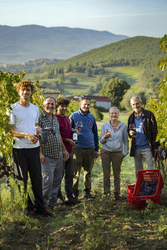
Two families, one estate. The Fabbro and Gjilaska families have farmed San Polino's 9.5 hectares side by side for three decades, with the second generation now running it, everything is grown, made, and bottled on site, 25,000 to 35,000 bottles a year.
Montalcino's original organic estate. San Polino was the first farm in the appellation to be certified organic, in 1994, and has been certified biodynamic since. This is a thirty-year record in a region where the language of sustainability is now universal and the documentation rarely is.
Documented as a working vineyard since 1581. The farmstead appears in Montalcino hospital records from that year, listed with a vineyard and six olive trees, the same six still stand in front of the house, and the family still presses them.
AN ABANDONED HILLSIDE, NEVER TOUCHED BY CHEMICALS
Katia Nussbaum first drove down to San Polino in September 1989 and found a farmstead that had been empty for decades: no electricity, no running water, and brambles over the front steps. What she and Luigi Fabbro bought the following year was a hillside of no commercial value and considerable agronomic value, land that had never seen a herbicide or a pesticide. Fabbro, who had spent years mapping biodiversity in the Amazon and studying indigenous permaculture, knew what that was worth. Their brief was not to restore the site but to avoid damaging it. Olive oil came first; the first Sangiovese went in the ground in 1998, and the first Brunello was the 2001, and it won international critical acclaim immediately.
TWO SITES, TWO KINDS OF BRUNELLO
The home vineyard sits at 450 meters on a south-facing slope ringed by scrub and forest, on thin, geologically diverse soils: volcanic quartz from Monte Amiata over Pliocene sandy loam and marine fossils, with marl veins running through. Hot days, Sahara winds, cold nights, low yields, thick skins: this is the source of the flagship Helichrysum and, in the strongest vintages, the Riserva. Four and a half hectares to the northeast, at 300 meters on deeper clay and marl, give plumper fruit and more immediate generosity and make the estate Brunello and the Rosso. In the cellar the approach is the same for both: hand harvest, spontaneous fermentation in truncated-cone oak vats, long macerations, aging in large Slavonian casks with French barriques used for texture rather than flavor, minimal sulfur, and no filtration.
FARMING AS RESEARCH
San Polino's position is that a wine's balance and complexity are a direct reflection of the biological richness of the place it came from, and the estate keeps testing what that means. Compost is made on site, wildflowers and legumes are sown between the rows, fields are left unfenced most of the year, bees are kept, and even sulfur is avoided in the vineyard on the grounds that it disrupts insect life. Working with university researchers, the family sprays preparations made from forest humus and green compost so that no single pathogen can dominate a competitive microbial community. Since 2018 they have been reintroducing trees to the vineyard, an Etruscan and Roman practice, interplanting Tuscan field maple among the vines for shade, fungal networks, and heat resilience. It is climate adaptation at the level of the ecosystem rather than the trellis.
A wine can only be as good as the ground it comes from, and this family has spent thirty-five years proving this to be true.
Owner :
Luigi Fabbro
Varietals planted :
Sangiovese
Winery production :
23,000-30,000 bottles
Winemaker :
Luigi Fabbro, Giulio Fabbro, Daniel Fabbro, Alberto Gjilaska
Total acres planted :
9 hectares (22 acres)
Your pdf has been sent with success.